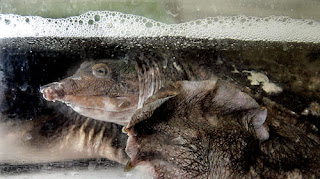
The reptiles, especially softshell turtles, are prized in China as food and as a source for traditional medicines. U.S. experts fear the trade could lead to extinctions.
The turtle tank at Nam Hoa Fish Market is empty, but not to worry: The manager of this bustling Chinatown store says he has plenty in back.
"Big ones," he says, spreading his hands as wide as a Christmas turkey.
He nods to a worker, who slides a large, waxed-cardboard box from a stack behind the counter and strips off the lid. Inside is a squirming burlap bag, from which he dumps two 15-pound softshell turtles that hit the concrete with a clop, then flail helplessly on their backs.
"Miami," the shopkeeper says of the reptiles' origins. "All from Miami."
Fresh off a plane at Los Angeles International Airport, one of the hubs of the sprawling international turtle trade, the critters will help feed a huge and growing appetite for freshwater turtles as food and medicine.
The demand pits ancient culture against modern conservation and increasingly threatens turtle populations worldwide. As Asian economies boomed, more and more people began buying turtle, once a delicacy beyond their budgets. Driven in particular by Chinese demand, Asian consumption has all but wiped out wild turtle populations not just in China, but in Laos, Vietnam, Cambodia and elsewhere in the region. Now conservationists fear that the U.S. turtle population could be eaten into extinction.
"It's insatiable," says Matt Aresco, a Florida biologist and director of the private Nokuse Plantation conservation reserve in the Florida Panhandle. "If we harvested every single turtle in Florida and sent every single one to Asia, there would still be a demand for more," he says. "That's how scary it is."
Federal law prohibits the capture of endangered or protected species. But it does not cover common turtles such as Florida's softshells, whose widely varying population estimates range from 4 million to 20 million. Softshells also abound in other, mostly Southern, states, some of which, including Texas, Oklahoma, Alabama and Mississippi, have banned or severely limited commercial harvests. Until recently, Florida had no limits on softshell harvests.
In Chinese communities around the world, turtles are coveted for their meat, which is thought to enhance longevity and sexual prowess. They're also used to make tonics believed to boost the immune system, and for other traditional medicines intended to treat an array of ailments, including cancer, arthritis and heart disease.
Carl Chu, the author of "Finding Chinese Food in Los Angeles," recalls growing up in his native Taiwan and watching as turtles' heads were cut off and their blood mixed with alcohol, then drunk as an aphrodisiac. It's one small illustration of an age-old Chinese belief that all kinds of food are therapeutic, he says.
"Anything that can be eaten is eaten to obtain some medicinal effect, and that includes turtles," he says.
Helen Nguyen, who has owned Nam Hoa Fish Market for 26 years, says that many of the turtles she sells for $6.99 a pound, before butchering, end up as soup in Chinese restaurants in Alhambra and Monterey Park, communities with large Asian populations.
The big, brownish-green softshells are most desirable because a 12-pounder will yield about half its weight in meat, she says. Its leathery shell also can be steamed and eaten.
"Most often, older people eat it," Nguyen says. "For the body. For the health. Makes you healthy."
In 1999, an international consortium of biologists and others estimated that the Asian turtle trade had grown to about 10 million of the reptiles a year, or 30,000 a day. By many accounts, demand has since grown dramatically.
During the peak season in late summer and early fall, the creatures are pulled by the thousands from Florida lakes, rivers, ponds, canals, drainage ditches and abandoned phosphate pits.
Those who catch them typically use baited hooks on trotlines, some stretching for miles. Their catch is bagged, boxed and shipped live to U.S. customers on both coasts and the Gulf of Mexico -- and to Asian gateways such as Hong Kong and Taiwan.
One Florida seafood dealer said his company had processed up to 20,000 pounds a week -- a couple of thousand adult turtles. Another broker ships nearly that much, according to a Florida Fish and Wildlife Conservation Commission report this year.
Many of the shipments go through LAX.
"In rough numbers, it's probably about 800 turtles a week, and they're going to southern China and Hong Kong," says Joe Ventura, an inspector with the U.S. Fish and Wildlife Service in Los Angeles. "It used to be a luxury item there. Now it's just a routine thing that people eat."
Although U.S. turtle farms have multiplied and now raise huge numbers of softshell turtles, almost all are hatchlings, according to Aresco and Kevin Enge, a Florida state biologist. Hordes are sold to Chinese turtle farms as breeding stock, they say.
In March, Aresco and 33 other turtle experts wrote to Florida's wildlife commission, seeking to limit the commercial take to one a day per person.
"Every boatload of turtles removed from a water body will take years, or even decades, to replace," they wrote. "Turtles cannot replace themselves like gray squirrels, whitetail deer, or even alligators."
Florida Gov. Charlie Crist also has weighed in, calling for a ban on the commercial harvest of softshell turtles.
So too has the Center for Biological Diversity, which argues that current harvest levels are unsustainable. The Arizona-headquartered group also says many wild turtles are contaminated with mercury, PCBs and pesticides.
Opponents of harvest limits include John Thomas, 75, whose father founded Thomas Fish Co. in Polk County in 1937. He has made his living from central Florida's lakes and waterways for more than five decades and says "there's no reason to worry about the turtles."
"We have got 8,000 lakes in this state and they've all got turtles in them," says Thomas, one of Florida's biggest dealers. "We have got hundreds and hundreds of phosphate pits and all kinds of creeks, some of them that run for miles and miles. And all of them have turtles in them. They are full of turtles."
Thomas, who describes fried turtle as "somewhere between chicken and frog legs, but with a different taste all its own," says that only in the last couple of years has demand for the reptiles been strong enough to make them profitable.
A few years ago, he says, "nobody bought live turtles, except for the people who put them in their aquariums."
Commercial fisherman Leo Gillis, 66, plies South Florida's 730-square-mile Lake Okeechobee.
"You can go out there anywhere on the lake and catch a few turtles," he says.
"In the middle, in the grass -- it don't make no difference. And Okeechobee has so many miles of marsh areas where you can't even get to them -- they multiply like all get-out in there."
During peak season, Gillis says, he was bringing in "400 or 500 bucks a day" selling live turtles to dealers for $1.50 a pound.
Florida's wildlife commission in September imposed a temporary, 20-turtle-a-day limit for commercial fishermen, while it considers a longer-range solution. Enge, the state biologist, thinks that's reasonable.
"I don't think we could extirpate the softshells if we tried," he says.
"Because of the biology of the species and the amount of habitat, I think 20 a day is probably a sustainable harvest forever. But due to public sentiment and all of that, I wouldn't be surprised if that number gets changed."
Thomas and the fishermen he buys from say that 20 turtles a day is not enough to be profitable. Conservationists contend that it is far too many.
Multiplying the daily limit by 150 to 200 licensed commercial fishermen, it works out to a potential harvest of more than 1 million turtles a year. Aresco says that represents about 27% of Florida's softshells, although state wildlife officials say the population is far larger.
Jeff Miller, a spokesman for the Center for Biological Diversity, predicts demand will only accelerate for what he calls "these amazing creatures."
"They've been around for hundreds of millions of years and have survived climate change and lots of other things," he says.
"And now we're about to eat them out of existence -- in the blink of an eye, biologically speaking."
(L.A. Times)
 BEIJING - Scientists in China say they have discovered the world's largest dinosaur fossil site in the eastern province of Shandong, state media reported on Tuesday.


